JivaVet
by JivaJet Inc.
Cold Atmospheric Plasma · Veterinary
0%
Cold atmospheric plasma · veterinary device

One device. Three indications. Drug-free.

JivaVet is a handheld cold atmospheric plasma multijet that delivers reactive oxygen & nitrogen species directly to the lesion — healing wounds, clearing resistant infections, and treating skin lesions in companion animals. Non-thermal, non-invasive, non-contact.

Plume ≤ 40 °C Contact none Sedation none Resistance none
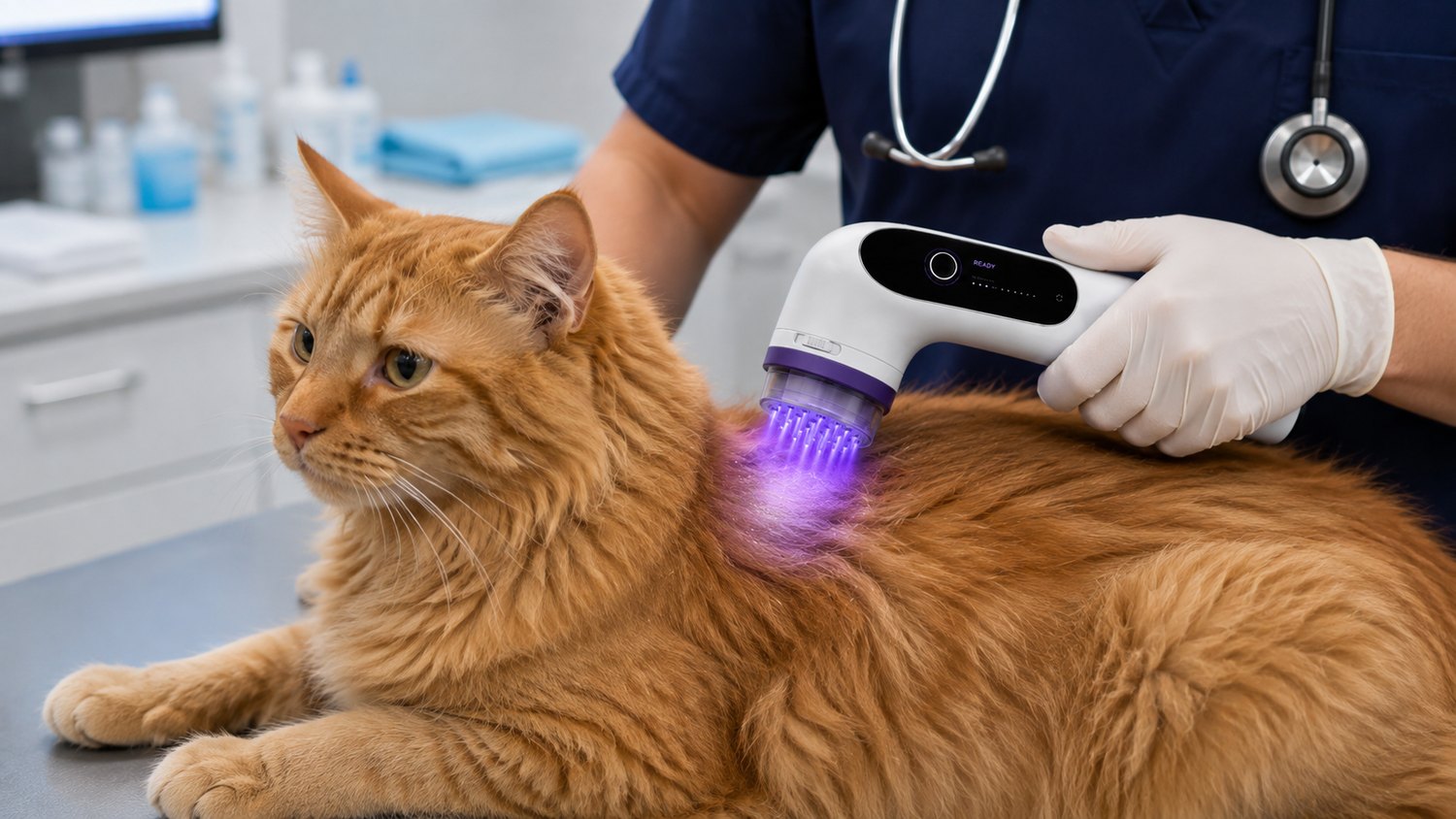
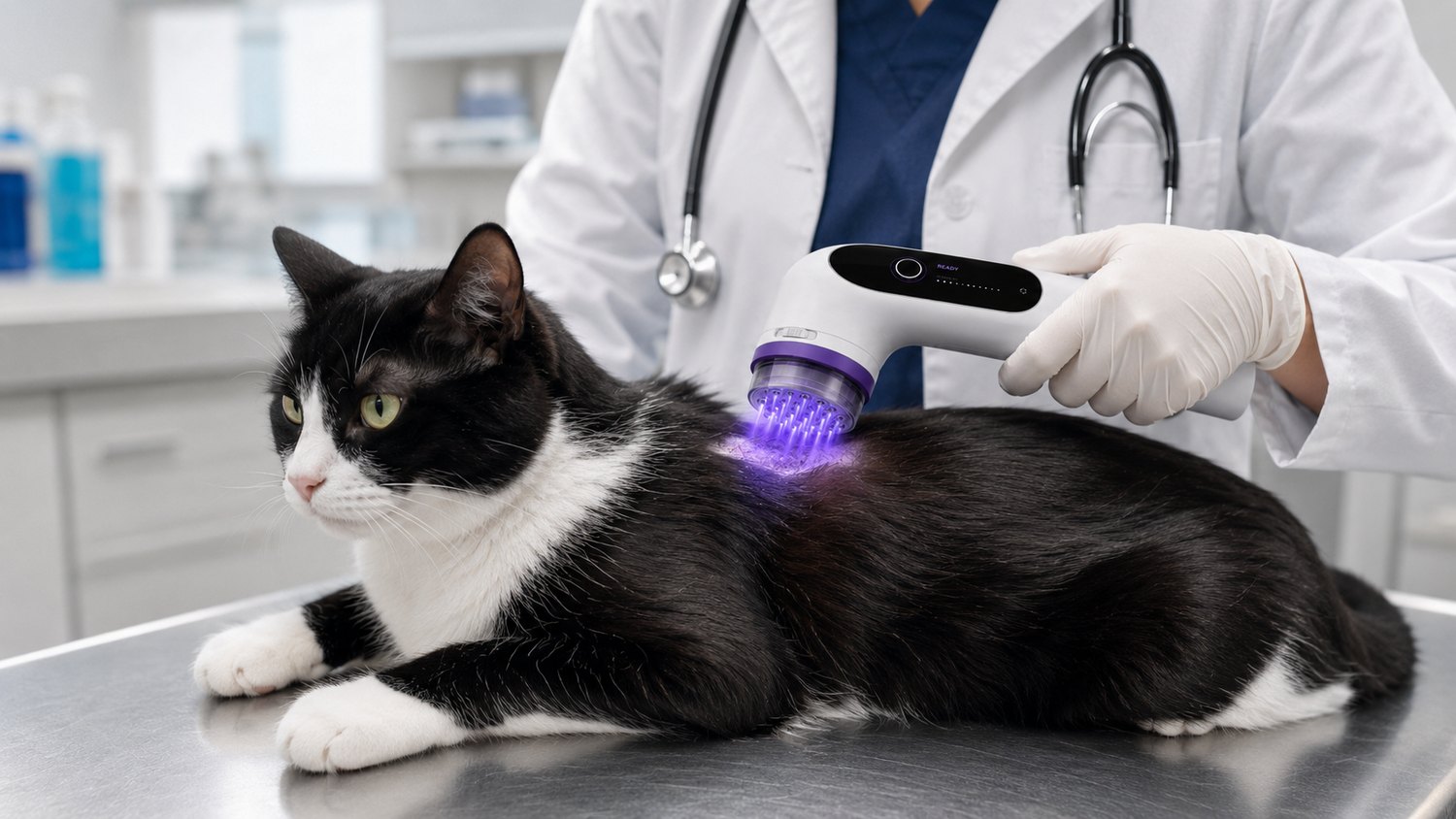
A veterinarian treating a cat with the JivaVet cold plasma handpiece Live · CAP multijet plume Awake · sedation-free · ≤ 40 °C
Our story

It started with FDA science — then with Delilah.

Dr. Soni's FDA work using cold atmospheric plasma to inactivate antibiotic-resistant bacteria and viruses during the SARS-CoV-2 pandemic laid the scientific foundation. But it was Delilah's months of needless suffering that made the mission personal — and exposed the urgent need for better companion-animal skin, wound, infection, and cancer care.

Costly vet visits

$200+ every visit — the bills mounted fast with no resolution in sight.

Long wait times

Repeated delays before she could even be seen or treated.

Ineffective treatment

Traditional pills, ointments and injectables only prolonged a painful recovery.

Medication failure

Delilah refused her medicines and licked off every ointment — and kept suffering.

JivaVet exists so no pet — and no owner — ever has to go through that again.
What is cold atmospheric plasma

The fourth state of matter, cooled to skin temperature.

Add energy to a gas and its atoms ionize — electrons break free and the gas becomes electrically active. Stars, lightning, and the aurora are all plasma. Ionize only a tiny fraction of the particles at atmospheric pressure, and the result stays cool enough to touch living tissue: cold atmospheric plasma.

It keeps all of plasma's reactive chemistry while shedding the heat — a physical therapy delivered as a cool violet plume, held just above the skin.

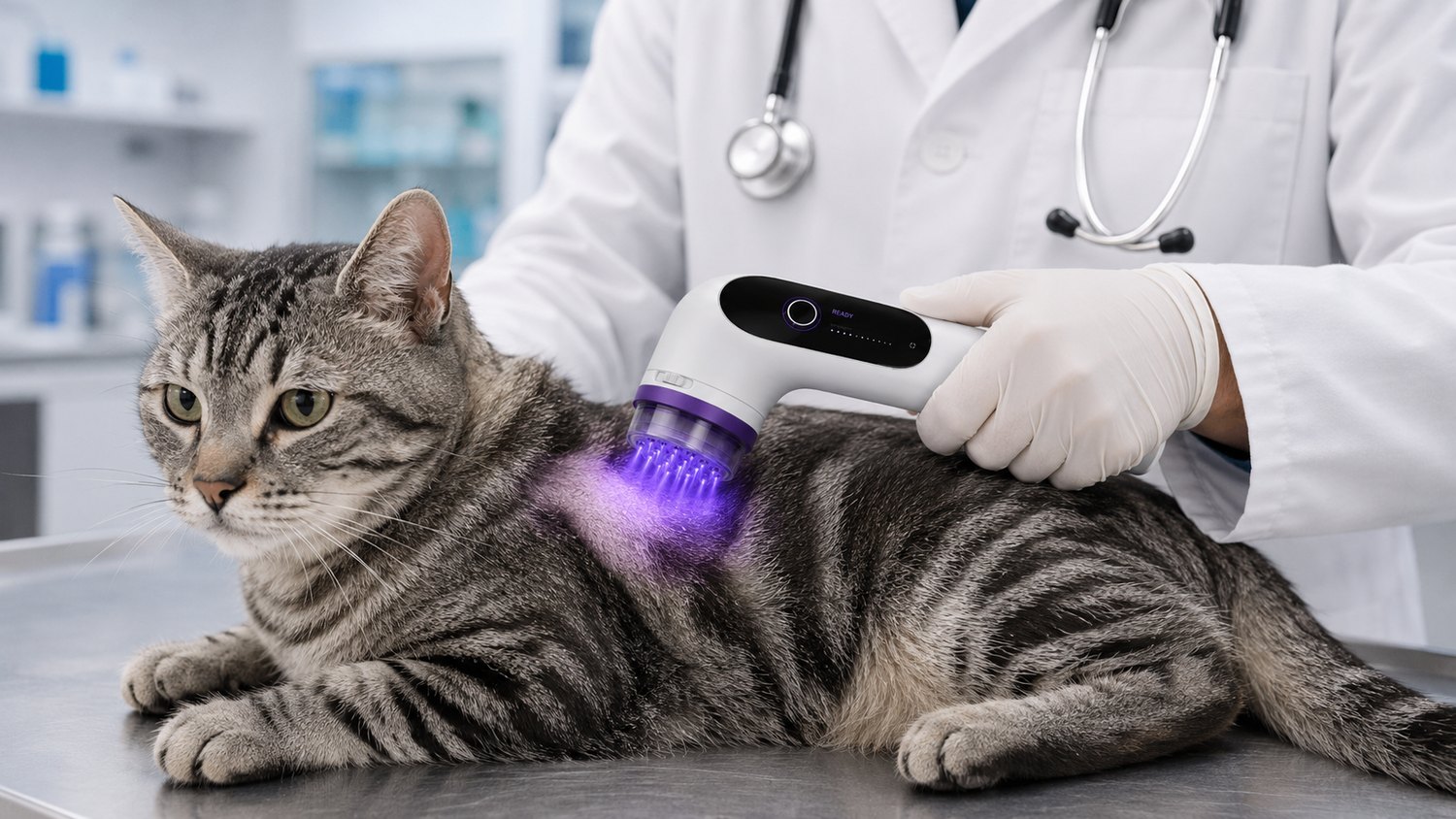
Cold plasma plume from the JivaVet device on a cat Ionized gas · ≤ 40 °C Solid · liquid · gas · plasma
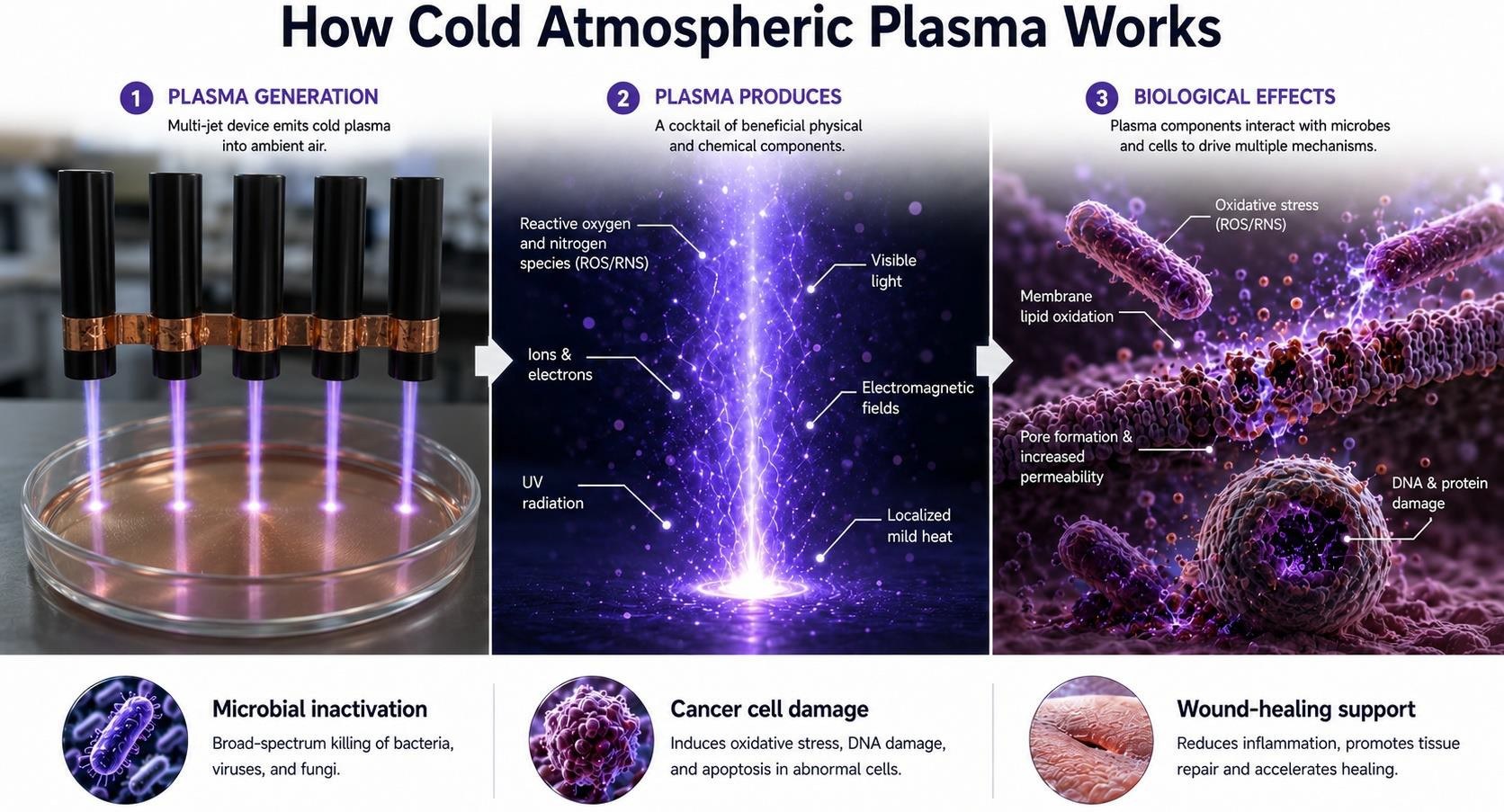
How cold atmospheric plasma works: generation, reactive species, and biological effects Mechanism of action
How it works

From gas to healing — and back to air.

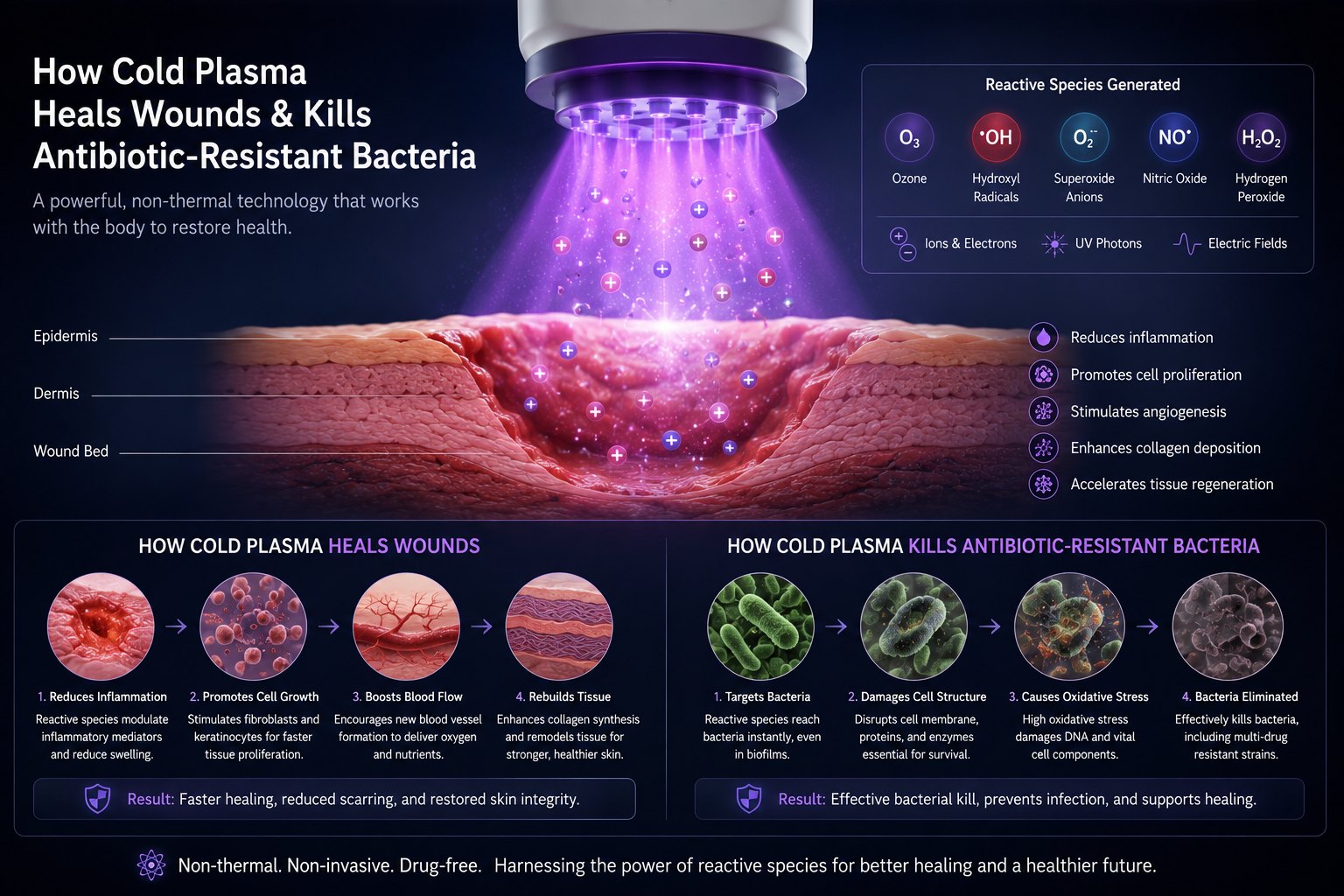
The handpiece ionizes a carrier gas into a stable plasma plume. That plume generates reactive oxygen and nitrogen species (RONS) — ozone, hydroxyl radicals, nitric oxide, hydrogen peroxide, superoxide — right at the tissue surface, along with visible light, low-dose UV, and weak electric fields.

These act for seconds, then decay back into ordinary air. Nothing is added to the patient, and nothing is left behind.

01Plasma generationCarrier gas ionizes into a stable cold plume at each of the five jets.
02Reactive species deliveryReactive oxygen & nitrogen species reach the lesion surface.
03Oxidative stressSpecies overwhelm pathogens' limited capacity to buffer it.
04Pathogen inactivationMembranes, biofilm and DNA disrupted; pathogens cleared.
05Tissue regenerationHealthy cells buffer the dose; healing signaling is stimulated.
06Selective sparingHealthy tissue buffers the same dose that destroys pathogens — targeted effect, no collateral damage.
The payload

Reactive species.

Cold atmospheric plasma generates a diverse mix of reactive oxygen and nitrogen species (ROS/RNS) that drive its biological effects — short-lived, highly reactive, and delivered in a controlled dose.

O₃ ozone·OH hydroxylO₂⁻ superoxideNO· nitric oxide H₂O₂ peroxide¹O₂ singlet ONO₂ nitrogen dioxideONOO⁻ peroxynitrite
The reactive oxygen and nitrogen species generated by cold atmospheric plasma ROS / RNS network
Why it works

A physical attack pathogens can't evolve around.

CAP exploits a weakness shared by pathogens and tumor cells — a limited capacity to buffer oxidative stress — while healthy mammalian tissue tolerates and even benefits from the same dose.

Pathogens & tumor cells destroyed

  • Oxidative stress — reactive species oxidize lipids, proteins and DNA.
  • Membrane & biofilm disruption — micropore formation exposes bacteria antibiotics can't reach.
  • DNA damage — double-strand breaks halt replication.
  • No resistance — a multi-front physical attack, effective on MRSP / MRSA, with no documented resistance.

Healthy tissue protected & stimulated

  • Buffered dose — mammalian repair machinery absorbs the oxidative load.
  • Microcirculation — improved oxygen and nutrient supply to the wound bed.
  • Regeneration — fibroblast proliferation, collagen and pro-healing growth-factor signaling.
  • No thermal damage — plume stays at or below 40 °C, no current through the patient.
The technology · JivaVet's multijet

An engineered 5×1 multijet array.

Most cold-plasma tools are single-electrode pens that treat one point at a time. JivaVet's patented 5×1 multijet array fires five synchronized cold-plasma jets in parallel — covering roughly five times the area per minute, with a uniform, repeatable dose across the whole lesion.

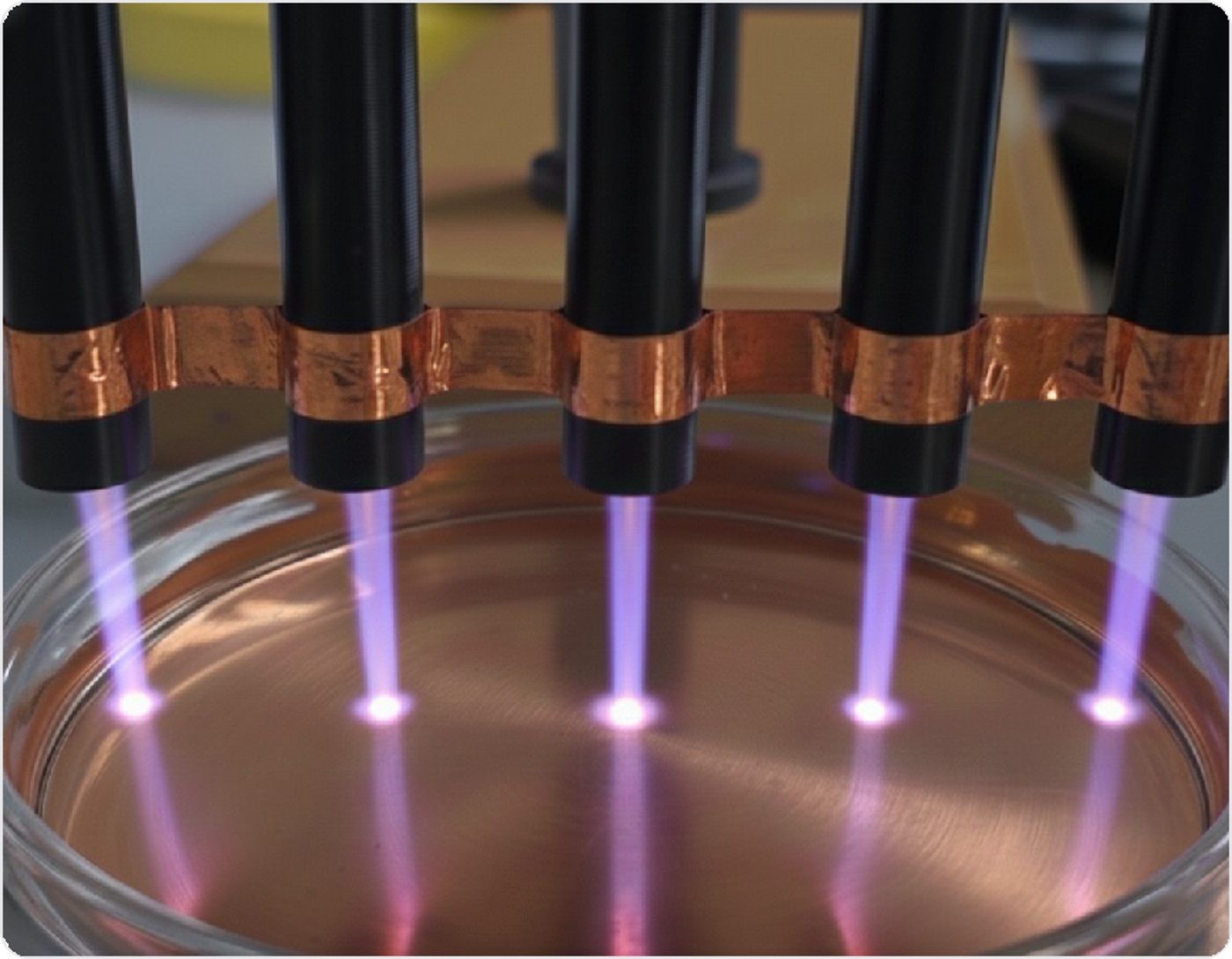
This is the real array in the laboratory: five violet plasma plumes striking in unison, driven by an atmospheric-pressure plasma jet at 10–20 kHz.

5×1 synchronized jets~5× area / minuteAPPJ · 10–20 kHzPlume 18–43 °CPatent PCT/US24/48415
The JivaVet 5×1 multijet array firing five violet cold-plasma jets onto a dish 5×1 multijet array · firing Real array · laboratory
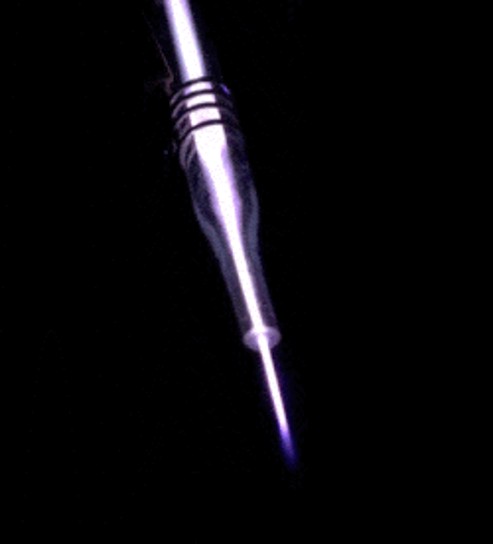
A single cold-plasma jet plume in detail Single-jet plume · detail He feed · violet afterglow
Inside a single jet

One jet, in detail.

Each jet channels a helium feed through a high-voltage discharge, producing a stable, luminous plume rich in reactive species — yet cool enough to hold above living tissue with no contact and no current through the patient.

  • Feed gasHelium / argon
  • DischargeAPPJ · RF/AC · 10–20 kHz
  • Standoff~10 mm · non-contact
Optical emission spectrum · JivaJet 5-jet CAP array

The plume's optical fingerprint confirms the reactive species that drive antimicrobial and antitumor activity — measured under a helium feed at atmospheric pressure.

Optical Emission Spectrum — JivaJet 5-Jet CAP Array (He feed, atmospheric pressure)
OH 308 N₂ 337 N₂⁺ 391 N₂⁺ 428 He 587 He 706 O 777 O 844 200 300 400 500 600 700 800 WAVELENGTH (nm) Close to Nozzle (dominant) Middle of Plasma No Plasma Contact Reference: Soni et al., Cancers (Basel) 13, 4485 (2021) | Patent: WO2025072333A1
How JivaVet works

An engineered 5×1 multijet.

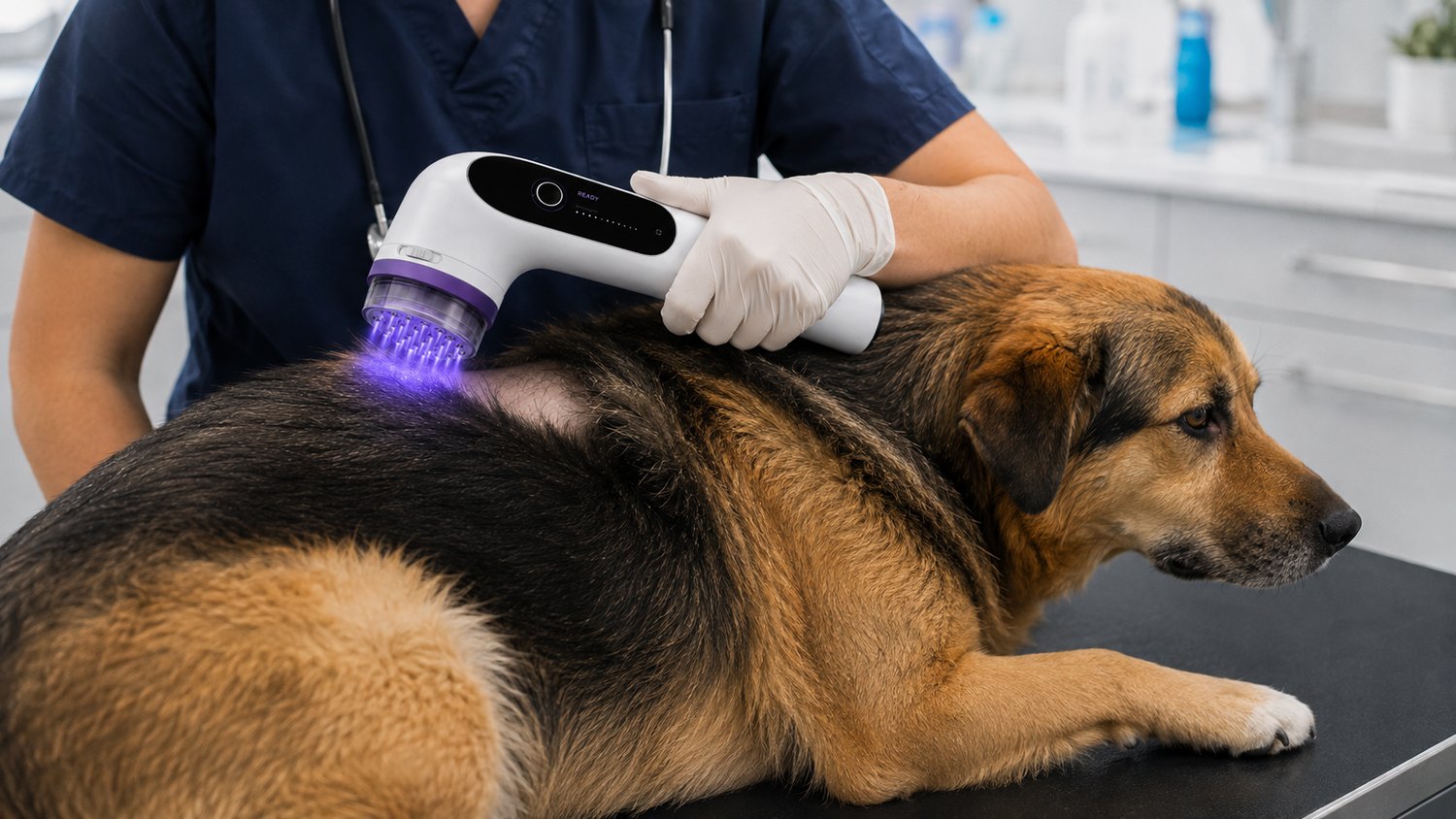
Where single-point plasma pens treat site by site, JivaVet's patented 5×1 multijet array delivers a uniform, repeatable dose across the treatment area — roughly five times the area per minute. Handheld, awake-safe, cage-side.

  • DischargeAPPJ · RF/AC · 10–20 kHz
  • Plume temperature18–43 °C · non-contact
  • Coverage5×1 array · ~5× area/min
  • Treatment area2–200 cm² · single-use tips
  • PortabilityMobile · cage-side · intra-op
  • PatentPCT/US24/48415
The JivaVet handpiece treating a dog, showing the multijet plume and READY display 5×1 multijet · He feed Handheld · READY
≤ 40 °CPlume at tissue
0Area / minute
0Pathogen kill (log₁₀)
0Drugs · anesthesia
STEP 01Activate the deviceStart with the touch control on the handpiece.
STEP 02Attach the multijet tipMount the appropriate sterile applicator tip.
STEP 03Position over targetHold at the optimal 10 mm standoff from the margin.
STEP 04Begin treatmentDevice stops automatically when the set time ends.
Prepare treatment area
Treatment with JivaVet™
Continue standard care

Sterile, single-use tips enable a 2–200 cm² treatment area; the device can be repositioned across larger margins in a single session. The applicator maintains optimal standoff with no direct tissue contact — safe to delegate to clinical staff.

Indications

One platform. Three indications.

The same cold-plasma engine addresses three large, distinct clinical needs in companion animals — wound healing, antimicrobial resistance, and cancer — drug-free and non-invasive.

01

Wound healing

Decontaminates the wound surface and accelerates re-epithelialization — for post-surgical, traumatic, and chronic non-healing wounds.

02

Antimicrobial resistance

A physical, multi-front kill effective on resistant organisms — including MRSP and MRSA — with no documented resistance, reaching biofilm antibiotics can't.

03

Cancer

Induces oxidative stress, DNA damage, and selective apoptosis in transformed cells while sparing surrounding healthy tissue.

Indication 01 · Wound healing

Wounds that stopped closing

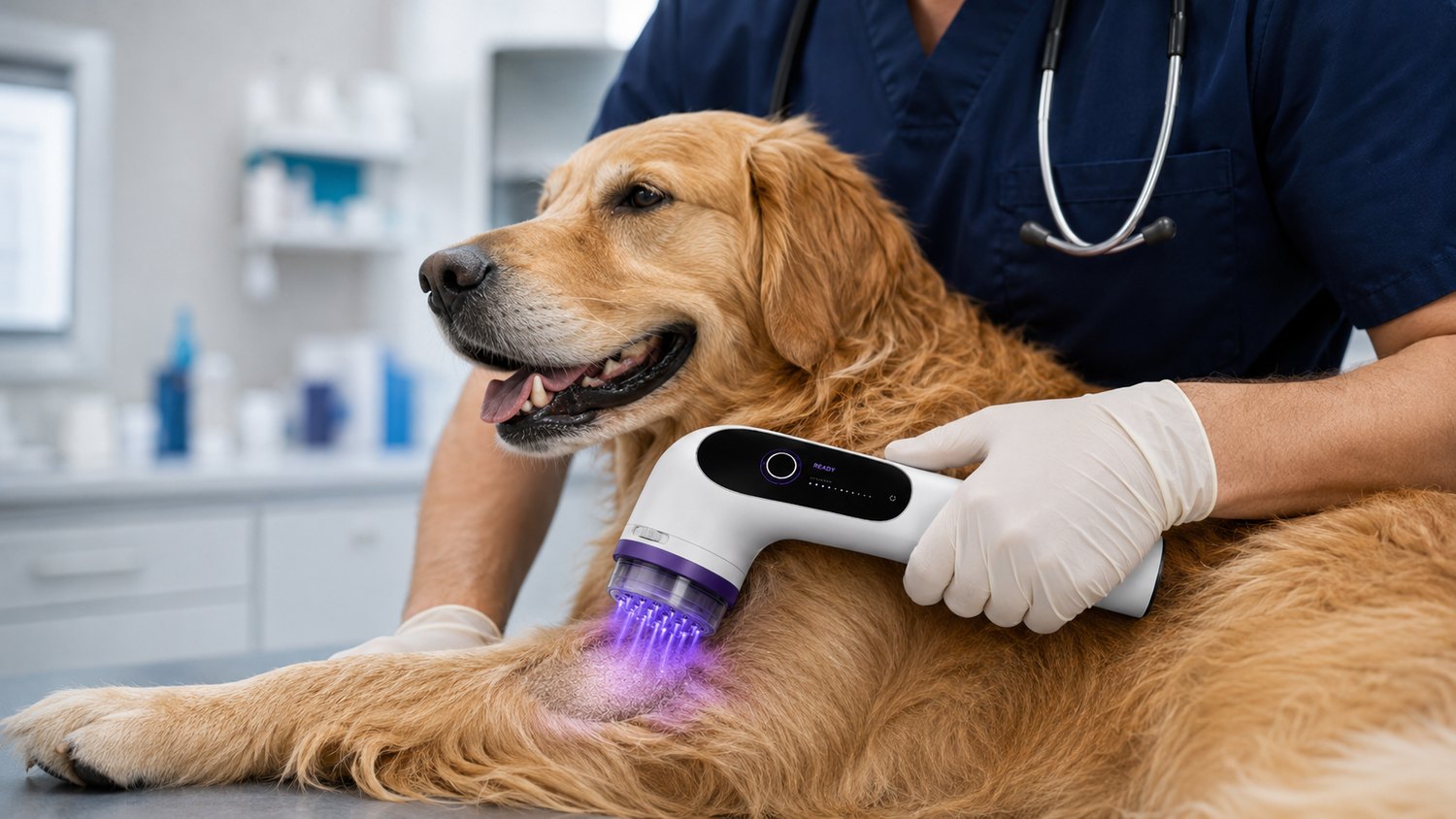
Cold plasma decontaminates the wound surface and stimulates the tissue's own repair machinery. Reactive species clear the pathogens and biofilm that stall healing, while the same dose nudges fibroblast proliferation, collagen synthesis, and pro-healing growth-factor signaling — accelerating re-epithelialization in wounds that had plateaued.

  • Mechanism — surface decontamination + improved microcirculation and tissue regeneration.
  • Delivery — non-contact, awake, ≤ 40 °C, no withdrawal period.
  • Evidence — 59% vs 5% complete closure vs best-practice dressings at 6 weeks (Strohal, Sci Rep 2022); 2× faster healing in a diabetic-mouse model in JivaVet FDA/GWU testing.
Conditions treated
Post-surgical incisionsSurgical dehiscenceTraumatic wounds Chronic non-healing woundsPressure & decubitus ulcersBurns & abrasions Lick granulomasInterdigital woundsDiabetic / ischemic wounds
Wound treatment on a dogWound healing
Indication 02 · Resistant infections

Resistant skin & ear infections

Where antibiotics act on a single target that mutation can route around, cold plasma attacks physically and on several fronts at once — oxidative stress, membrane and biofilm disruption, and DNA damage. It reaches the biofilm that antibiotics can't penetrate, with no documented resistance across repeated exposure.

  • Resistant organisms — effective on MRSP and MRSA, including multi-drug-resistant strains.
  • Kill — ≥5-log₁₀ bacterial reduction (≈99.999999%), incl. Gram-negatives.
  • Evidence — canine skin/ear bacteria incl. MRSP (Jin, Vet Dermatol 2021); anti-biofilm vs P. aeruginosa (Kim, 2022); MRSA/E. coli decolonisation (Daeschlein, PLoS One 2012); canine otitis externa split-body trial (Bakır & Ulutas, 2026).
Conditions treated
Superficial & deep pyodermaHot spots (acute moist dermatitis)Otitis externa Atopic dermatitis flaresMRSP / MRSA infectionsBiofilm-associated infections Fungal / dermatophyte lesionsAbscesses & infected woundsInterdigital furunculosis
Resistant infection treatment on a catResistant infection
Indication 03 · Oncology

Cutaneous & soft-tissue lesions

Cold plasma induces oxidative stress, DNA double-strand breaks, and selective apoptosis in transformed cells — while mammalian repair machinery buffers the same dose in surrounding healthy tissue. A drug-free, anesthesia-free option for visible cutaneous and soft-tissue lesions, as an adjunct within the veterinarian's plan.

  • Mechanism — RONS-mediated selective apoptosis; healthy tissue spared.
  • Result signal — 81.5% apoptosis in controlled studies; histology-confirmed remission.
  • Evidence — CAP anticancer effects in canine osteosarcoma (Lee, Int J Mol Sci 2020); feline cutaneous SCC CAP pilot (2023).
Conditions treated
Squamous cell carcinoma (SCC)Cutaneous mast cell tumorsSoft-tissue sarcomas Papillomas & wartsActinic / pre-cancerous lesionsIntra-operative tumor margins Superficial melanomasRecurrent skin nodules
Skin lesion treatment on a catCutaneous lesions
Market

A ~$23B global market, growing to ~$36B by 2030.

One device addresses three large, fast-growing companion-animal markets — wound care, dermatology, and oncology.

$1.5B
Animal wound care
Global TAM 2025 · 7.5% CAGR
$20.1B
Veterinary dermatology
Global TAM 2025 · 8.5% CAGR
$1.7B
Veterinary oncology
Global TAM 2025 · 12.1% CAGR

Sources: Mordor / SkyQuest / Precedence (wound) · MarketsandMarkets / Grandview (dermatology) · Grandview / Mordor (oncology).

The evidence

Results from published studies and real-world cases.

CAP-class results drawn from published in-vitro, in-vivo and clinical veterinary studies — alongside a real-world companion-animal case series.

0
Apoptosis
Induced in transformed cells in controlled studies
≥5-log₁₀
Bacterial kill
≈99.999999% reduction — incl. MRSA & biofilm; Gram-negatives
59% vs 5%
Complete remission
Histology-confirmed, versus control
≤ 40 °C
Non-thermal plume
No contact, no current through the patient

Preclinical device results. JivaVet's own FDA / GWU testing demonstrated 5-log₁₀ bacterial kill and accelerated wound healing in a diabetic-mouse model — validating the multijet architecture that carries the CAP-class biology into the clinic.

Apoptosis, kill and remission figures reflect CAP-class results from published in-vitro, in-vivo and clinical veterinary studies. Individual results vary; JivaVet is an adjunct to veterinary care.

Clinical & preclinical evidence

  • Yoo J et al. Cold atmospheric microwave plasma for wound healing in dogs & cats. J Vet Sci 2023;24(4):e56.
  • Strohal R et al. Chronic wounds: CAP jet vs best-practice dressings. Sci Rep 2022 (59% vs 5% at 6 wks).
  • Jin H-J et al. CAP vs canine skin/ear bacteria incl. MRSP. Vet Dermatol 2021;32:462.
  • Kim E-J et al. CAP anti-biofilm vs P. aeruginosa. Vet Dermatol 2022;33:29.
  • Daeschlein G et al. CAP decolonisation of MRSA/E. coli. PLoS One 2012;7:e34610.
  • Bakır & Ulutas. CAP in canine otitis externa (split-body trial). Vet Dermatol 2026.
  • Lee J et al. CAP anticancer effects in canine osteosarcoma. Int J Mol Sci 2020;21:4556.
  • Feline cutaneous SCC CAP pilot, 2023. PetCell® — Cold Plasma Therapy in Small Animal Practice, Case Studies 2025.

Technology basis

  • JivaJet Inc. Vet CAP Multijet Datasheet & Whitepaper; OES analysis of 5×1 array prototype.
  • Global Patent PCT/US24/48415 (WO2025072333A1) — CAP Multijet Architecture.

Preclinical device results (5-log₁₀ kill; diabetic-mouse wound healing) are from JivaVet — FDA / GWU testing. Market figures are first-order projections scaled from peer-reviewed CAP data.

FAQ

Asked in every clinic.

Does it hurt?

No. The plume is non-thermal and never contacts the tissue, with no current passing through the patient. Sessions are done awake, without sedation — most animals react more to the faint sound of the gas flow than to the treatment itself.

Does it replace antibiotics or surgery?

No. JivaVet complements every protocol — a tool for when conventional options have been exhausted, or when a practice is reducing antibiotic use. Diagnosis and clinical judgment remain entirely with the veterinarian.

Why can't bacteria develop resistance?

Antibiotics act on a single metabolic target that mutation can route around. CAP attacks physically and on several fronts at once — oxidative stress, membrane and biofilm disruption, DNA damage — leaving no single pathway for resistance to evolve, even in MRSP/MRSA.

Is anything left on or in the patient?

No. The reactive species act at the surface for seconds and then revert to ordinary air. No residue, no systemic exposure, no withdrawal period.

What is the regulatory position?

JivaVet is a veterinary device. In the United States, veterinary devices fall under FDA-CVM oversight and do not require 510(k) or PMA premarket clearance — a materially faster path to market. JivaVet is not intended for use in humans.

The team

Scientists, engineers and operators.

JivaVet is built by a team spanning plasma physics, device engineering, and company-building — grounded in a decade of university plasma-medicine research.

Founders & leadership

Shashank Kaul
Shashank KaulCo-Founder & CEO
Dr. Michael Keidar
Dr. Michael KeidarCo-Founder & Chief Scientific Advisor
Dr. Anmol Taploo
Dr. Anmol TaplooCo-Founder & CTO
Dr. Vikas Soni
Dr. Vikas SoniFounder & Chief Scientific Officer

Programs & engineering

Jake Spinelli
Jake SpinelliAerospace Design Engineer
Guru S. Duppada
Guru S. DuppadaPropulsion Scientist

Advisors

Dr. Roger Myers
Dr. Roger MyersTechnical Advisor · ex-Aerojet Rocketdyne
Bob Smith
Bob SmithAdvisor
Dr. Melissa Patton
Dr. Melissa PattonStrategic Advisor
Dr. Peter Gollub
Dr. Peter GollubAdvisor
Dr. Suresh Joshi
Dr. Suresh JoshiAdvisor · MD, MSc, PhD (Surgery)
Get in touch

Bring cold plasma into your practice.

We work with wound, dermatology and referral practices. Reach out for information, literature, or a demonstration.

Email us +1 703-373-7715
Company

JivaJet Inc.

Innovation Possible with Plasma

CAGE 04K13 · UEI JAQ8CKM1RFL6

Office

1655 Fort Myer Drive, Suite 718
Arlington, VA 22209, USA

+1 703-373-7715

Reach us

info@jivajet.com

Investor inquiry
investors@jivajet.com

www.jivajet.com